

NZ Company Tax Rate vs. Sole Trader: A Strategic Comparison
- Peter Eastmure
- Feb 22
- 11 min read

Choosing the right business structure is one of the most critical financial decisions a professional in New Zealand will make. The path you select-operating as a sole trader or forming a company-has profound implications for your tax obligations, personal liability, and long-term wealth strategy. For many, the flat 28% company tax rate nz appears attractive, yet it introduces complexities around compliance and accessing profits. This uncertainty can lead to hesitation and costly indecision, creating stress where there should be confidence.
This strategic comparison is designed to provide the clarity you need. We will meticulously break down the fixed company tax rate against the progressive tax rates applicable to sole traders. By exploring the key differences, the methods for drawing income, and the compliance responsibilities of each structure, you will gain the confidence to select the framework that best aligns with your professional goals. Our aim is to empower you to make a proactive decision that ensures your financial future is built on a solid, tax-efficient foundation.
Key Takeaways
The flat 28% company tax rate nz offers initial simplicity, but its strategic advantage depends on your business's net profit and how you plan to extract funds.
A sole trader's profit is taxed at progressive personal rates, creating a crucial income threshold where a company structure becomes more tax-efficient.
Discover the tax implications of extracting company profits, comparing shareholder salaries against dividends to optimise your personal income.
Move beyond a purely tax-based comparison to weigh other critical factors, including limited liability protection, administrative burden, and long-term strategic goals.
Table of Contents The New Zealand Company Tax Rate: A Flat 28% Sole Trader Tax: Understanding Progressive Income Rates Worked Examples: Tax Calculation for a Company vs. Sole Trader Extracting Profits: Shareholder Salaries and Dividends Beyond Tax: Strategic Factors in Choosing Your Business Structure
The New Zealand Company Tax Rate: A Flat 28%
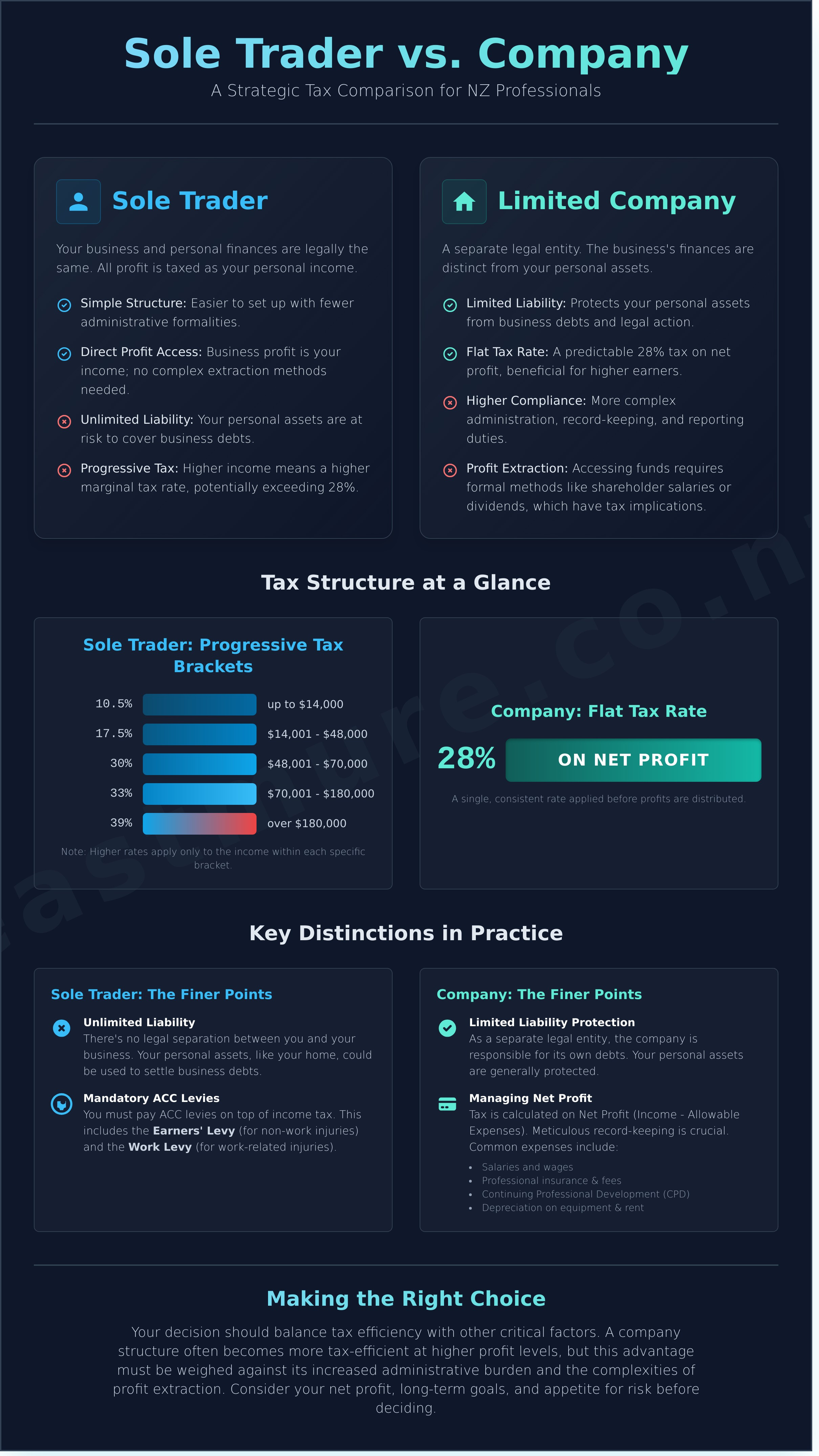
For the 2026 financial year, the official company tax rate nz is a flat 28%. This single, consistent rate is applied to a company's net profit before any profits are distributed to shareholders as dividends. It applies uniformly to all registered companies operating within New Zealand, from large corporations to smaller, specialised practices.
This rate has been a stable feature of New Zealand's tax system for over a decade, providing a predictable and clear framework for businesses to conduct their financial forecasting and strategic planning. Understanding how this rate applies to your specific business structure is the first step toward achieving both compliance and tax efficiency.
What is Net Profit?
Net profit is the figure upon which your company tax is calculated. It is defined as your company's total income minus all its allowable business expenses. For professionals, ensuring every legitimate expense is claimed is fundamental to managing tax exposure. Common allowable expenses include:
Salaries and wages paid to staff
Professional indemnity insurance premiums
Annual practising certificate fees and professional body memberships
Costs for continuing professional development (CPD)
Depreciation on medical or specialist equipment
Rent for commercial premises and related utilities
Meticulous record-keeping is not merely a compliance task; it is a strategic necessity to ensure the precision of your tax calculations and provide a clear audit trail.
Who Pays This Tax?
The 28% company tax rate applies directly to the profits of standard limited liability companies. It is also the starting point for Look-Through Companies (LTCs), although the final tax liability is handled differently. In an LTC, profits and losses are "looked through" and passed directly to the shareholders, who then pay tax at their personal marginal rates.
It is critical to distinguish this corporate income tax from other business taxes. It is entirely separate from your obligations for Goods and Services Tax (GST), Pay As You Earn (PAYE) deductions for employees, and Fringe Benefit Tax (FBT), each of which has its own distinct rules and payment cycles.
Sole Trader Tax: Understanding Progressive Income Rates
While a limited company benefits from a single, flat tax rate on its profits, the tax obligations for a sole trader are fundamentally different and require meticulous management. For a sole trader, there is no legal distinction between the individual and the business. Consequently, all business profit is treated as personal income and is taxed accordingly.
This structure means your earnings are subject to New Zealand's progressive income tax system, where the rate of tax increases as your income rises. This contrasts sharply with the fixed company tax rate nz applied to incorporated entities. Understanding this progressive model is the first step toward strategic tax planning and ensuring full compliance with Inland Revenue.
NZ's Individual Income Tax Brackets
Your total income is assessed against a series of tax brackets. It is critical to understand that you only pay the higher rate on the portion of your income that falls within that specific bracket, not on your entire income. For the 2025-2026 financial year, the marginal tax rates are:
10.5% on income up to NZ$14,000
17.5% on income from NZ$14,001 to NZ$48,000
30% on income from NZ$48,001 to NZ$70,000
33% on income from NZ$70,001 to NZ$180,000
39% on income over NZ$180,000
For example, if your profit is NZ$60,000, you will not pay 30% on the full amount. Instead, each portion of your income is taxed at its corresponding bracket rate, which results in a lower overall effective tax rate.
The Impact of ACC Levies
In addition to income tax, sole traders must also pay Accident Compensation Corporation (ACC) levies on their liable earnings. This is a distinct and mandatory cost that provides comprehensive, no-fault personal injury cover. These levies are comprised of two parts:
The Earners' Levy: This covers the cost of non-work-related injuries.
The Work Levy (CoverPlus): This is specific to your business activity and covers work-related injuries.
Proactive financial management requires factoring these levies into your tax planning, as they represent a significant cost on top of your income tax obligations. This holistic view is essential when comparing the financial implications of operating as a sole trader versus leveraging the company tax rate nz within a formal company structure.
Worked Examples: Tax Calculation for a Company vs. Sole Trader
To provide clarity on the financial implications of your business structure, we have prepared a series of worked examples. These scenarios illustrate how tax liabilities differ between a sole trader and a company at various profit levels, using the flat company tax rate nz of 28% against progressive personal income tax rates. For precision, all examples use current tax and ACC levy rates for illustrative purposes.
Scenario 1: Net Profit of NZ$70,000
At this income level, the progressive personal tax rates often result in a lower overall tax bill for an individual.
Sole Trader Tax: Based on progressive rates, the income tax is NZ$14,020. Adding the ACC Earner's Levy (approx. NZ$1,120) brings the total liability to NZ$15,140.
Company Tax: The calculation is straightforward. NZ$70,000 profit multiplied by the 28% corporate tax rate results in a total liability of NZ$19,600.
In this scenario, the sole trader structure is more tax-efficient.
Scenario 2: Net Profit of NZ$150,000
As income surpasses key thresholds, the benefit of the fixed corporate rate becomes apparent, especially for businesses focused on retaining capital for growth.
Sole Trader Tax: With more income falling into the 33% tax bracket, the income tax rises to NZ$40,420. With the capped ACC levy (approx. NZ$2,281), the total liability is NZ$42,701.
Company Tax: The consistent 28% rate on NZ$150,000 profit results in a total liability of NZ$42,000.
At this point, the company tax rate nz provides a slight advantage for profits retained within the business, creating opportunities for reinvestment.
Scenario 3: Net Profit of NZ$200,000+
At higher profit levels, the tax efficiency of a company structure becomes significant. The highest personal tax rate of 39% creates a substantial gap compared to the 28% corporate rate.
Sole Trader Tax: Income now enters the 39% bracket, leading to an income tax bill of NZ$58,120. Including the capped ACC levy, the total liability is NZ$60,401.
Company Tax: The calculation remains simple: NZ$200,000 profit at 28% results in a total liability of NZ$56,000.
This demonstrates a clear tax saving of over NZ$4,400. However, this profit is retained by the company. Extracting it requires strategic planning, typically through shareholder salaries, which are then taxed at personal rates. This is where proactive tax advice becomes essential to optimise your overall financial position.
Extracting Profits: Shareholder Salaries and Dividends
A fundamental principle of company structure is that the business is a separate legal and tax entity. The profits it generates are not automatically the personal funds of the owner. Extracting this value requires a deliberate, strategic approach to ensure tax efficiency and compliance. For business owners in New Zealand, this process typically involves two primary mechanisms: shareholder salaries and dividends.
The balance between these methods is one of the most critical areas for proactive tax planning. A carefully considered structure can significantly minimise overall tax exposure, while a poorly planned one can lead to unnecessary costs. The key is to understand how each method interacts with both the corporate and personal tax systems.
The Role of a Shareholder Salary
A shareholder salary is remuneration paid to a shareholder for the work they actively perform within the company. This payment is treated as a standard business expense, meaning it is deductible against the company’s income. This action directly reduces the company's total taxable profit. The salary is then taxed at the shareholder's individual marginal tax rates, which range from 10.5% to 39%.
Understanding Dividends and Imputation Credits
Dividends are distributions of a company’s after-tax profits to its shareholders. Because the company has already paid tax on these profits at the flat 28% company tax rate nz, New Zealand’s tax system uses imputation credits to prevent double taxation. These credits represent the tax the company has already paid.
When a shareholder receives a dividend, the attached imputation credits reduce the amount of personal income tax they owe on that income. If the shareholder's personal tax rate is higher than 28%, they are required to pay a "top-up" tax on the difference. For instance, a shareholder on the top 39% tax rate would need to pay the additional 11%.
Determining the optimal mix of salary and dividends is a strategic decision that depends entirely on your personal income levels and financial objectives. Achieving a structure that provides clarity and confidence requires meticulous planning. To discuss a strategy tailored to your specific circumstances, we invite you to contact our specialists for a private consultation.
Beyond Tax: Strategic Factors in Choosing Your Business Structure
While understanding the current company tax rate nz is a critical component of financial planning, selecting the most effective business structure requires a far broader perspective. The lowest possible tax bill rarely tells the whole story. A truly strategic decision weighs tax efficiency against other crucial factors like personal liability, administrative demands, and your long-term commercial ambitions. This foresight is what separates reactive accounting from proactive wealth protection.
Making the right choice from the outset provides a stable foundation for growth and ensures your structure serves your goals, not the other way around. Below, we outline three pivotal considerations beyond the tax rate.
Limited Liability Protection
Perhaps the most compelling reason to form a company is the legal protection it affords. A company is a separate legal entity from its owners (the shareholders). This creates a crucial distinction: if the business incurs debt or faces legal action, creditors can typically only make a claim against the company's assets. Your personal assets, such as your family home and savings, remain protected. This stands in stark contrast to a sole trader structure, where there is no legal separation, and you bear unlimited personal liability for all business debts.
Administrative Complexity and Costs
The benefits of a company structure are accompanied by a higher level of compliance. Companies in New Zealand must meet specific obligations, including filing an annual return with the Companies Office, maintaining company records, and documenting major decisions through formal resolutions. These duties are more demanding than the simpler requirements for a sole trader. Consequently, the associated professional and accounting fees are generally higher, a factor that must be deliberately weighed in your decision-making process.
Perception, Succession, and Investment
Your business structure directly influences how it is perceived by clients, lenders, and potential investors. A registered company often projects an image of greater professionalism, stability, and permanence. Furthermore, a company structure is built for the future. It provides a clear and straightforward mechanism for succession planning or selling the business through the transfer of shares. This same framework makes it significantly easier to bring on new partners or attract investment to fund growth, offering a level of flexibility that is essential for ambitious enterprises.
Ultimately, the optimal structure is one that aligns with your specific circumstances, risk tolerance, and vision for the future-not just the prevailing company tax rate nz. The right structure depends on your long-term goals. Let's discuss your situation.
Making the Strategic Choice for Your Financial Future
As we've explored, the decision between operating as a company or a sole trader extends far beyond a simple comparison of tax rates. While the flat 28% company tax rate nz offers apparent simplicity, the optimal structure depends entirely on your income level, plans for profit extraction, and long-term strategic goals. The right choice is a foundational element of your financial success, influencing not just your tax obligations but also your personal liability and capacity for growth.
Navigating these complexities requires foresight and precision. As specialist advisors for medical professionals and high-net-worth individuals, we focus on proactive tax strategy and robust wealth protection to provide clarity and peace of mind for your complex financial affairs. To ensure your business structure is meticulously aligned with your objectives, we invite you to arrange a confidential consultation to determine the optimal structure for your financial goals.
Making an informed decision is the first step toward lasting financial clarity and confidence.
Frequently Asked Questions
What is the NZ company tax rate for the 2025 financial year?
For the financial year ending 31 March 2025, the company tax rate in New Zealand is a flat rate of 28%. This rate is applied to a company's net profit before any distributions, such as dividends, are made to its shareholders. Proactive financial management and meticulous record-keeping are essential to ensure this liability is accurately calculated and provisioned for, providing clarity and confidence in your company's compliance obligations with the Inland Revenue Department (IRD).
At what income level does a company structure become more tax-efficient than a sole trader?
A company structure typically offers greater tax efficiency once personal taxable income surpasses NZ$70,000 per annum. Above this threshold, a sole trader's marginal tax rate becomes 33%, which is higher than the flat 28% company tax rate. By operating as a company, profits can be retained and taxed at the lower rate. However, careful planning is required for shareholder salaries and dividends to ensure overall tax optimisation is achieved with precision.
How is company tax paid to the IRD?
Company tax is paid to the Inland Revenue Department (IRD) primarily through a provisional tax system. This requires companies to make instalment payments throughout the year, typically based on the previous year's profit or an estimation of the current year's earnings. Following the end of the financial year and the filing of the annual tax return, a final calculation is made. Any outstanding amount is paid as terminal tax, while any overpayment is refunded, ensuring compliance is managed deliberately.
Can I leave after-tax profits in my company?
Yes, it is both permissible and often strategically advantageous to leave after-tax profits within the company. These funds are classified as 'retained earnings' on the balance sheet and represent capital that can be used for future investment, debt reduction, or business expansion. The profit has already been taxed at the flat company rate. These earnings can be held within the company indefinitely, providing a stable financial base for long-term growth and wealth protection.
Does changing from a sole trader to a company trigger any tax obligations?
Yes, transitioning from a sole trader to a company is a significant event that can trigger specific tax obligations. The transfer of business assets, such as equipment or goodwill, from the individual to the new corporate entity is treated as a sale. This can result in taxable income from depreciation recovery or create GST liabilities that require careful management. A proactive and precisely planned transition is essential to minimise tax exposure and ensure full compliance from the outset.
Is the tax rate for a trust the same as a company?
No, the tax rate for a trust is distinct from and currently higher than the corporate rate. As of 1 April 2024, the trustee income tax rate is 39%, whereas the company tax rate nz remains at a flat 28%. This considerable variance underscores the importance of strategic structuring for asset protection and tax minimisation. The optimal choice between a trust, a company, or a combination of structures depends entirely on your specific financial circumstances and long-term objectives.


Comments