

NZ Tax Codes Explained: A Complete Guide for Employees & Professionals
- Peter Eastmure
- 16 hours ago
- 11 min read

For many New Zealand professionals, the array of letters on a tax form-M, ME, S, SH-can be a source of significant uncertainty. Selecting the correct option often feels like a matter of guesswork, leading to legitimate concerns about facing an unexpected tax bill at the end of the year. The system of tax codes NZ employs is fundamental to ensuring your PAYE deductions are accurate, yet it is frequently misunderstood. This lack of clarity can create unnecessary financial stress and compliance risk.
This comprehensive guide is designed to remove that ambiguity and provide absolute clarity. We will explain precisely how to differentiate between primary and secondary codes, confidently select the right one for your specific circumstances, and recognise when an update is required. Our goal is to replace confusion with confidence, giving you the peace of mind that comes from knowing your tax obligations are being managed with precision and foresight from the very start.
Key Takeaways
Your tax code is a critical instruction to your employer that directly determines the amount of PAYE tax deducted from your income, ensuring correct compliance from the start.
Differentiating between primary and secondary income sources is essential for tax accuracy, as you can only designate one source of income as your primary one.
Understanding the main tax codes nz offers, from the standard 'M' code to specific codes for contractors or superannuitants, provides crucial financial clarity.
You must proactively update your tax code whenever your circumstances change to prevent significant under or over-taxation and maintain financial peace of mind.
Table of Contents What is a Tax Code and Why is it Crucial? Decoding the Main NZ Tax Codes for Primary Income Navigating Secondary Tax Codes for Additional Income Special Tax Codes for Specific Scenarios How to Action and Update Your Tax Code
What is a Tax Code and Why is it Crucial?
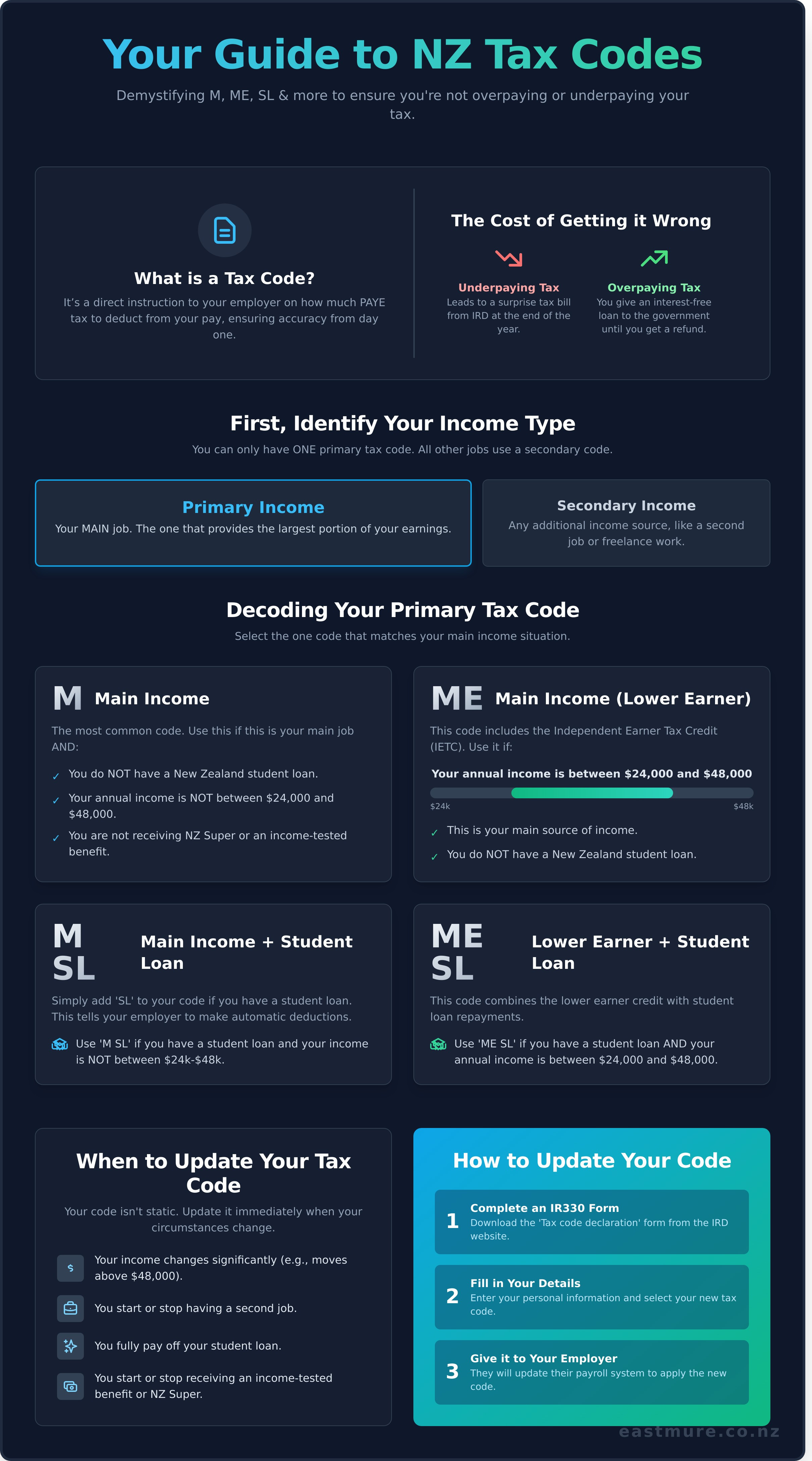
Think of your tax code as a direct instruction you provide to your employer or payment provider. It is a simple combination of letters that communicates your specific financial circumstances, ensuring they deduct the correct amount of income tax from your pay. This mechanism is the cornerstone of New Zealand's Pay As You Earn (PAYE) system, a framework designed for seamless tax collection throughout the financial year.
The primary function of all tax codes nz is to achieve precision in your tax obligations. The system of Taxation in New Zealand is structured to collect revenue progressively, and your tax code is the key that aligns your income with the correct deduction rate. Using the right code is not merely an administrative task; it is a fundamental component of proactive financial management, preventing unwelcome surprises from Inland Revenue (IRD).
The Cost of Getting it Wrong: Tax Bills vs. Refunds
An incorrect tax code creates a financial imbalance that is only rectified at the end of the tax year. This typically results in one of two undesirable outcomes:
Underpaying Tax: If your code causes insufficient tax to be deducted, you will face a surprise tax bill from the IRD after your income is reconciled. This can create unexpected financial pressure.
Overpaying Tax: Deducting too much tax means you are essentially providing the government with an interest-free loan. While you will receive a refund, that capital could have been better utilised for investment or managing cash flow.
A correct tax code ensures financial predictability, which is essential for effective wealth management and achieving peace of mind.
Who Needs a Tax Code?
A tax code is required for anyone receiving income from a New Zealand-based payer. You must provide your code, typically via an IR330 Tax code declaration form, if you are:
An employee earning a salary or wages.
A contractor receiving schedular payments.
A recipient of NZ Superannuation or a veteran's pension.
Failing to provide a code will result in deductions at a high "no-notification" rate, leading to significant overpayment of tax until it is corrected.
Decoding the Main NZ Tax Codes for Primary Income
Your primary source of income is your main job-the one that provides the largest portion of your earnings. Your employer uses a specific tax code to calculate and deduct the correct amount of PAYE (Pay As You Earn) tax from your salary or wages. Selecting the right code is a critical component of your personal tax compliance, preventing unexpected bills or significant overpayments. The various tax codes NZ employers use are detailed in Inland Revenue's official NZ tax code guide and are designed to align your tax deductions with your circumstances, providing clarity and peace of mind.
M - The Default Code
The 'M' tax code is the most common and is considered the default for most New Zealand employees. You should use this code if the position is your main source of income, you do not have a New Zealand student loan, and you are not receiving specific income-tested benefits or NZ Superannuation. It is the standard code for the majority of the workforce.
ME - For Lower-Income Earners
The 'ME' code is specifically for individuals whose total annual income is expected to be between NZ$24,000 and NZ$48,000. This code incorporates the Independent Earner Tax Credit (IETC), which reduces the amount of tax you pay throughout the year. It is crucial to be proactive here; if your income increases beyond NZ$48,000, you must update your code to 'M' to avoid a tax liability at year-end.
M SL and ME SL - The Student Loan Codes
If you have a student loan from StudyLink, the letters 'SL' must be added to your tax code (e.g., 'M SL' or 'ME SL'). This suffix instructs your employer to automatically deduct student loan repayments from your pay. These deductions only begin once your income surpasses the annual repayment threshold, which is currently NZ$22,828. This system ensures your loan obligations are managed seamlessly.
Tax Code Description Primary Criteria M Main Income Your primary job with no student loan. ME Main Income (Lower Earner) Annual income is between NZ$24,000 - NZ$48,000. M SL Main Income with Student Loan Your primary job and you have a student loan. ME SL Main Income (Lower Earner) with Student Loan Annual income is NZ$24,000 - NZ$48,000 and you have a student loan.
Navigating Secondary Tax Codes for Additional Income
When you earn income from more than one source simultaneously-such as a second job, a contracting role, or a side business-it is classified as secondary income. Managing the tax on this income requires meticulous attention to detail, as New Zealand's tax system has specific rules to ensure you meet your obligations correctly throughout the year.
The most critical principle is that you can only use a primary tax code (like 'M' or 'ME') for your main source of income. All other sources must use a secondary tax code. This structure is designed to tax your additional earnings at a flat rate, preventing a significant tax shortfall at the end of the financial year. Using a primary code for a second job will result in under-taxation, leading to an unexpected and often substantial tax bill from Inland Revenue.
S, SH, ST - Tiered Rates for Secondary Jobs
Choosing the correct secondary tax code is a strategic decision based on your total estimated annual income from all sources combined. These codes apply a flat rate of tax to your secondary earnings to align with your overall marginal tax rate. The primary options are:
S Code: For total annual income between NZ$14,001 and NZ$48,000. Tax is deducted at 17.5%.
SH Code: For total annual income between NZ$48,001 and NZ$70,000. Tax is deducted at 30%.
ST Code: For total annual income between NZ$70,001 and NZ$180,000. Tax is deducted at 33%.
SA - For Secondary Income Over the Highest Threshold
For high-net-worth individuals and professionals whose total annual income exceeds NZ$180,000, the SA code must be used for all secondary income sources. This code applies New Zealand's top personal income tax rate of 39% as a flat deduction. Accurate application of the SA code is essential for maintaining tax compliance and ensuring that income from directorships, investments, or secondary professional roles is taxed appropriately from the outset. For a complete breakdown, Inland Revenue provides an Official guide to NZ tax codes that outlines these specific requirements.
Adding the 'SL' Component to Secondary Codes
If you have an outstanding student loan, your repayment obligations extend to all sources of income. Therefore, you must add the 'SL' identifier to your secondary tax code. This ensures that repayments are deducted seamlessly from your secondary pay, maintaining compliance and preventing arrears. The correct secondary tax codes nz residents with student loans would use are S SL, SH SL, ST SL, or SA SL, depending on their total income bracket. This proactive step provides clarity and peace of mind, ensuring all financial obligations are managed deliberately.
Special Tax Codes for Specific Scenarios
The standard PAYE system is designed for traditional employer-employee relationships, but not all income fits this model. For medical professionals, consultants, and individuals with diverse income streams, understanding special tax codes is essential for maintaining compliance and achieving financial clarity. These codes ensure that the correct amount of tax is deducted at the source for non-standard work arrangements.
Navigating these specific scenarios requires precision. While most income earners will use the primary and secondary codes discussed earlier, certain situations demand a different approach. The three most common special tax codes nz provides are for contractors, casual agricultural workers, and those receiving one-off payments.
WT - For Schedular Payments
The WT code is used for schedular payments, which are payments made to independent contractors, not employees. This is a critical distinction for professionals who operate on a contract basis, such as a locum doctor providing services to a clinic, a specialist consultant engaged for a specific project, or a director receiving fees. The payer deducts tax at a rate you specify on the Tax rate notification for contractors (IR330C) form, giving you control over your tax obligations and cash flow.
CAE - For Casual Agricultural or Orchard Workers
The CAE tax code is highly specific and applies only to casual seasonal workers in the horticulture or viticulture industries. To use this code, the work must be of a temporary nature, and the employee must not have worked for that same employer within the previous three months. It is not suitable for regular part-time or full-time staff in these sectors, who would use a standard tax code instead.
NSW - For Election Day Workers and Irregular Payments
The NSW code is for one-off payments where no other code is appropriate. Its most common use is for individuals who work for a single day during a general election. It can also apply to other irregular, short-term activities where an ongoing employment relationship does not exist. This code is distinct from regular casual employment, which typically requires using a primary tax code like 'M' or 'ME'.
Correctly identifying and applying these codes is a key component of proactive tax management. For strategic advice tailored to your professional circumstances, contact Eastmure & Associates Limited for clarity and confidence in your financial affairs.
How to Action and Update Your Tax Code
Selecting the correct tax code is the first critical step in managing your PAYE obligations. However, your financial circumstances are not static. Proactive management of your tax code is essential for ensuring ongoing compliance and preventing costly errors. A common oversight is failing to update your code after a significant life change, which can lead to a substantial tax bill or an overpayment that ties up your funds unnecessarily. Precision in this area provides financial clarity and peace of mind.
Completing Your Tax Code Declaration (IR330 Form)
The IR330 form is the official document you provide to your employer to declare your tax code. Its purpose is to give your employer the precise information needed to deduct the correct amount of PAYE (Pay As You Earn) tax from your salary or wages. You can download the most current version directly from the Inland Revenue (IRD) website. When completing it, pay meticulous attention to your personal details, your chosen tax code, and your KiwiSaver deduction rate if applicable.
Key Life Events That Require a Tax Code Review
Your tax code is not a "set and forget" detail. It must be reviewed and updated whenever your income situation changes to remain accurate. This proactive approach is fundamental to sound financial management, as using incorrect tax codes nz can have significant consequences. It is crucial to reassess your details following certain events:
Starting a new job or taking on a second source of income.
Receiving a significant pay rise that moves you into a higher tax bracket.
Paying off your student loan in full, which removes the 'SL' component from your code.
Starting or stopping receipt of a government benefit, ACC payment, or NZ Superannuation.
While these are common scenarios, individuals with more complex income structures face greater compliance challenges. For those with earnings from investments, trusts, or self-employment, professional advice is invaluable for maintaining accuracy and optimising your financial position. Contact us for a confidential review.
Mastering Your Tax Obligations with Confidence
Understanding and applying the correct tax code is a fundamental responsibility for every New Zealand employee and professional. As we've explored, the system of tax codes nz is designed to ensure accuracy-your code, whether primary, secondary, or special, directly impacts your PAYE deductions and ensures compliance. Regularly reviewing your circumstances and updating your details is not just good practice; it’s essential for maintaining financial clarity.
While this guide provides a solid foundation, complex financial profiles-particularly for medical professionals and high-net-worth individuals-demand a more strategic approach. As specialist accountants, we deliver proactive advice and discreet, tailored financial strategies to ensure you achieve both compliance and peace of mind.
For professional guidance on complex tax matters, schedule a confidential consultation with Eastmure & Associates.
Taking this proactive step ensures your financial affairs are managed with the precision and foresight they deserve, giving you the confidence to focus on what matters most.
Frequently Asked Questions About NZ Tax Codes
What happens if I use the wrong tax code in NZ?
Using an incorrect tax code results in either an underpayment or overpayment of tax to Inland Revenue. If you underpay, you will receive a tax bill at the end of the financial year, which can disrupt your financial planning. Conversely, overpaying means you have less cash flow throughout the year, essentially providing an interest-free loan to the government until your refund is processed. Ensuring your tax code is correct is a critical step for precise financial management.
Can I use the 'M' tax code for two jobs?
No, the 'M' tax code must only be used for your primary source of income. If you have a second job, you are required to use a secondary tax code for that income. Using 'M' for more than one employer will lead to a significant underpayment of tax, resulting in a substantial tax liability at the end of the year. It is imperative to allocate the correct primary and secondary codes to ensure compliance and avoid unexpected bills from IRD.
How do I find out what my current tax code is?
Your current tax code is typically displayed on your payslip. For a definitive confirmation, you can log in to your myIR account on the Inland Revenue website, where your tax details are securely stored. Alternatively, you may contact your employer's payroll or HR department, as they hold this information for PAYE purposes. Reviewing this periodically ensures your tax affairs remain accurate and compliant, providing you with financial clarity and peace of mind.
What is the difference between the S and SH tax codes?
Both 'S' and 'SH' are secondary tax codes, but the correct one depends on your total annual income from all sources combined. You should use 'S' if your total income is projected to be between NZ$14,001 and NZ$48,000. The 'SH' code applies if your total income is between NZ$48,001 and NZ$70,000. Selecting the appropriate code is essential for accurate tax withholding on your secondary earnings and is a key part of managing tax codes nz correctly.
Do I need to change my tax code if I pay off my student loan?
Yes, it is crucial to update your tax code once your student loan is fully repaid. You must remove the 'SL' component from your code (for example, changing from 'M SL' to 'M'). To do this, you will need to complete a new Tax code declaration (IR330) form and provide it to your employer. Failure to make this change will result in continued, unnecessary student loan deductions from your salary, impacting your net income.
What tax code should I use if I am semi-retired but still working?
Your tax code in semi-retirement depends on your income sources. If your sole income is from one part-time job, you would use a primary tax code such as 'M'. However, if you are receiving NZ Superannuation, that is considered your primary income source. In this scenario, your employment income is secondary, and you must use a secondary tax code (like 'S', 'SH', or 'ST') for your job to ensure the correct amount of tax is paid.
If I'm a contractor, do I use a normal tax code or something else?
As a contractor, you generally do not use the same employee tax codes. You are typically responsible for managing your own tax obligations, including paying provisional tax. In certain industries, your income may be classified as a schedular payment, where the payer deducts tax at a flat rate using the 'WT' code. Given the complexities of contractor tax, we recommend seeking professional advice to ensure full compliance and strategic financial management.

Comments